

A wellness mentorship for adults who refuse to coast on autopilot.

Reclaim your vitality.
Stop the grind. Start the game.

Itercycling turns behavior change into short-cycle games you can actually enjoy. Pick an aspect of your life that matters to you and play repeating cycles to make the change you want. If change is too hard or too easy, iterate and try again.

Stylized mountain path rising toward the light in a playful green spiral
●

Live progress · Cycle 5, Day 3/4

Lifted Weights 2/1 ✓ · Minutes Exercising 180/180 ✓

Play for what matters to you

A game can live in any part of your life — these are just a few suggestions. Run one game, or several at once.

Health

Improve your physical or mental condition by exercising regularly, eating better, sleeping more, or stressing less.

Work

Improve your work-life balance by keeping evenings and weekends work-free, taking a real lunch break every day, or using the vacation days you keep postponing.

Home

Make home life run more smoothly by sharing the housework fairly, cooking dinner at home instead of ordering takeout, or clearing the clutter that keeps piling up.

Spirit

Deepen your sense of meaning or peace by keeping a daily meditation practice, writing in a gratitude journal each evening, or spending time in nature every week.

The Core Contrast

The broken pattern of the Sacrifice Shuffle.

Most wellness regimens run on willpower and friction. The Itercycling method runs on fun and balance.

Traditional wellness

Driven by willpower

Asks you to give up what you love right now for a vague, far-off reward later.

The Itercycling approach

Driven by fun

Designed like a game you actually want to play. If it's fun, it's not a sacrifice.

Traditional wellness

High friction

Feels like a second job — the first thing dropped when life gets crowded.

The Itercycling approach

Low friction

Runs in short, winnable cycles. When life gets chaotic, you adjust the game — you don't abandon it.

Traditional wellness

The deprivation trap

Forces strict restriction, leading to eventual burnout, guilt, and a total system reset.

The Itercycling approach

Prospective balance

You can have the dessert or the drink. You just map it inside our Ophanim software so you enjoy it guilt-free and keep playing.

The Framework

How the Itercycling method works.

Three steps — a simple rhythm that bends around real life.

01

Choose Your Move

Pick an aspect of your life that matters to you — health, work, home, spirit, or anything else.

02

See Your Live Picture

You log your choices directly in our Ophanim software. No reconstructing the week from memory — just a clear, current picture of your cycle.

03

Keep the Game Alive

Repeat what works, change what doesn't, and choose a fresh challenge whenever you are ready for one.

Inside Ophanim

A clear picture, not guesswork.

Every choice you log feeds the same live picture your Navigator reads. Here's what the workspace actually looks like.

This tour plays on its own — hover to pause, or click a step to explore.

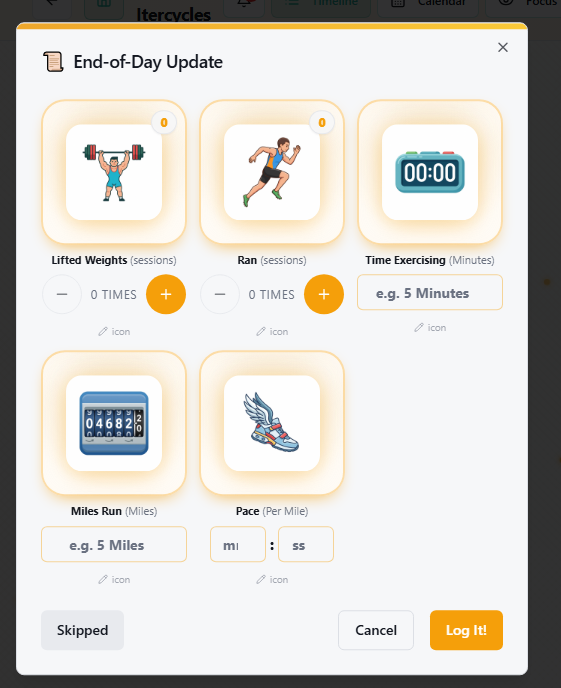
Ophanim end-of-day update dialog with tap-to-log fitness tiles

Step 1 — Log

Tap what you did.

A few taps a day captures the choices that shape your cycle.

The Support Difference

A clear live picture. Your choices stay yours.

Memory blurs the patterns that matter. Itercycle Navigators work with what is happening in your real life now.

Your Navigator reviews your live picture between conversations and helps you adjust — without judgment, without taking over. You remain in charge; the game stays balanced, enjoyable, and winnable.

The Private Mentorship Journey

From intent to repeatable wins — in four phases.

Every private client follows the same flexible four-phase rhythm. You remain in charge; your Navigator helps you read the patterns and protect the fun.

01

In-Person or Zoom

The Initial Alignment Session

Your move

Share what you want to change and what life looks like right now. Together, we choose a meaningful place to begin.

Navigator's role

Introduces the Itercycling method and helps you identify the behavior changes that best fit your life.

OutcomeA clear, winnable starting point shaped around your life and schedule.

02

In-Person or Zoom

The Two-Week Game Alignment

Your move

Run your first short-cycle game on your own schedule and notice where real life pushes back.

Navigator's role

Reviews your live picture and helps you adjust the game so it stays fun and winnable.

OutcomeA game shaped by real life rather than ideal conditions.

03

Remote Asynchronous Support

Ongoing Pattern Guidance

Your move

Play your games independently, on your own clock. Every change remains your choice.

Navigator's role

Watches your patterns in the background and helps you correct course when progress slows.

OutcomeSustained momentum through timely email support and periodic live conversations.

04

In-Person or Zoom

Strategic Progress Review

Your move

Review your progress, celebrate wins, and surface what emerged during your independent play.

Navigator's role

Reviews your trajectory and jointly decides with you whether to tackle new behavior changes or adjust the difficulty.

OutcomeA recalibrated game plan that keeps the challenge winnable and the momentum alive.

Client Stories

Real people. Real cycles. Real change.

Every client plays a game built around their own life. Here is how three of them turned the changes they wanted into wins.

From Inertia to Intention

A Marine veteran in his sixties

His weight was steadily climbing and everyday physical activities were getting harder. Another traditional diet felt like a non-starter.

He began with a simple three-day cycle and two targets. It took several tries to win the first cycle — but once he did, progress accelerated.

“Trying to hit my targets made me think about what I was eating for the first time in my life. Once I did that and realized I was often eating from inertia rather than hunger, changing my diet was easy. I thought giving up frequent snacks and desserts would be hard. Instead, it was fun.”

Flexible Targets, Consistent Progress

The president of a small technology company

He always wanted to write a book, but after almost five years he had 26 carefully polished pages — working on it had become a chore.

He set up a five-day cycle he could win by hitting any one of three targets: time spent writing, pages written, or chapters written. He finished the book in less than six months.

“I quickly began to look forward to sitting down with my laptop and working on my book. I could do this whenever I had some free time, no matter where I was, because it all helped me win the cycle. Pretty soon I made the targets harder, but I never changed the overall game. I really liked being able to decide each day whether I would focus on writing as many pages as I could or taking my time.”

From Hating Running to Choosing It

A woman in her late twenties

She had agreed with family members to race a 5K in four months — and she hated running. She exercised regularly, but running had long since dropped out of her life.

She set up four-day cycles with targets for running (duration, distance, and pace) alongside supporting behaviors like sleep and stretching, winning each cycle through consistent progress across the set.

“I still would rather play squash or do a HIIT class than run, but I no longer hate it. Being competitive, I care a whole lot about winning my Itercycles. This has made running my exercise of choice. I am shocked at this.”

Every story starts the same way — a conversation.

Start the conversation

Share a little about yourself. A Navigator will review your answers and follow up by email.

Explore the Ideas

Ideas for a more playable life.

Not ready to start the conversation? Read a few thoughts from the founder first — no form, no commitment.

Read all posts
When You're Ready

What would make life feel more alive?

Tell us what you want to change and what keeps getting in the way. A Navigator will read your answers personally and start the conversation from there.

Reviewed personally